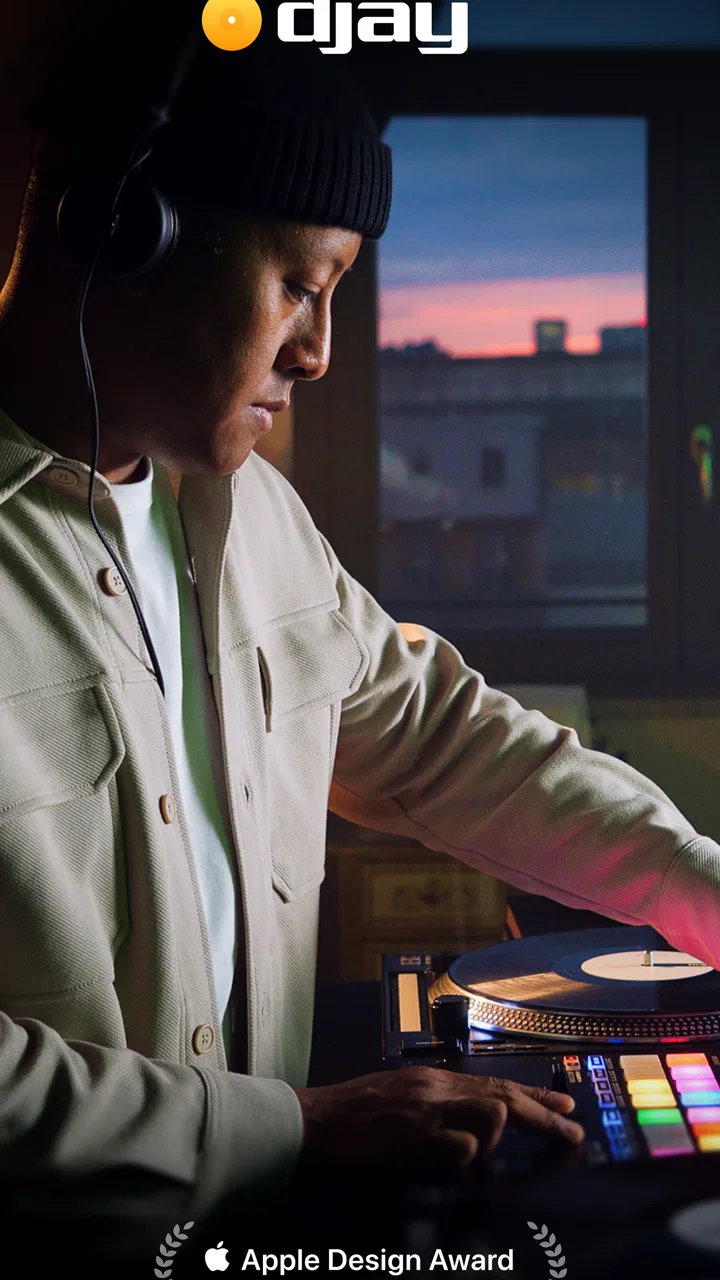
djay - DJ App & AI Mixer
- 3.8
- Rating
- 10.00M
- Installs
- Free
- Price

 Analysis by App-foxy
I approached djay - DJ App & AI Mixer as a beginner rather than as someone arriving with a controller and years of mixing experience. That makes a big difference with this Music & Audio app from Algoriddim. Its promise is easy to understand: put songs on virtual decks, blend them, and experiment with remixes. The more useful question is whether it helps a first-time user reach a satisfying result without feeling lost. In my experience, it can, provided you treat the first session as a guided experiment instead of trying to learn every control at once.
The app is free to install and suitable for Everyone, which lowers the barrier to trying it. It has been available since February 26, 2015, and supports devices running OS 10 or later. Its audience is clearly substantial, with more than ten million installs, although its average score sits at 3.9 from roughly 222 thousand ratings. I read that combination as a practical warning rather than a negative verdict: many people find the concept appealing, but the experience can depend heavily on the device, the music you use, and how comfortable you are with touch controls.
Getting from the first screen to a real mix
I’d use this section to focus on the small decisions that turn the deck view into a mix: choosing two familiar tracks, giving each control a clear purpose, and listening before making another adjustment. That approach makes the first session less about chasing effects and more about learning how timing and balance shape a handoff.
You May Also Like

 Blood Strike: 2.5 Anniversary
Blood Strike’s Loadouts Turn Every Drop Into a Tactical Gamble
A close look at Blood Strike’s custom loadouts: how fast access to signature weapons reshapes its battle royale rhythm, rewards preparation, and narrows the gap between fights.

 Pandora - Music & Podcasts
Pandora’s Music Is Easy to Start, but Harder to Recover
Pandora’s strength is its low-effort path from a seed to a station. Its weak spot is how much confidence it asks you to place in connection, setup, and quiet recovery.

 8 Ball Pool
 Is Built on Rivalries, Rematches, and Routine
A close look at the rivalries, rematches, shared routines, and unanswered safety questions that turn a quick pool match into a persistent mobile community.

 Samsung Music
’s Quiet Strength Is Playing What You Already Own
Its reach comes less from spectacle than from dependable access to a personal library. That simplicity is both the app’s strongest retention engine and its ceiling.

 AccuWeather: Weather Radar
AccuWeather Review: A Quick, Clear Forecast for Everyday Decisions
For everyday plans, the best forecast is the one you can understand quickly. AccuWeather makes rain timing, radar, and local conditions easy to act on, with a few trade-offs.

 Hill Climb Racing
Why Hill Climb Racing Still Turns Crashes Into One More Run
A tiny car, a bumpy hill and one more upgrade: Hill Climb Racing keeps resurfacing because its simple chaos makes every near-miss feel personal.
More From Our News Desk



What to expect before you begin
The first thing to understand is that this is not simply a music player with a play button. You are working with a DJ-style layout, so the app asks you to think in terms of two tracks, timing, transitions, and small changes in energy. That sounds complicated until you narrow the goal. Your first success should not be a polished club set. It should be a clean change from one song to another while keeping the music moving.
I recommend starting with two songs that have a similar mood and a steady rhythm. A dramatic change from a slow acoustic track to a fast electronic song can be fun later, but it makes the basic controls harder to understand. Choosing compatible music lets you hear what your actions are doing instead of wondering whether the poor result came from the transition or from the songs themselves.
The app’s store summary focuses on mixing music and remixing songs, and that is a fair description of its role. It is more hands-on than a normal streaming app, but less intimidating than beginning with physical decks, a mixer, cables, and a large collection of controls. I found the touch interface approachable for short sessions, especially when I concentrated on one action at a time.
There is also an important expectation to set around the free version. The app itself costs nothing to download, but in-app purchases range from $6.99 to $49.99 per item. That means you can explore the basic experience before spending anything, while some more advanced or expanded parts of the app may require a purchase. I would not buy an add-on during the first session. First find out whether you actually enjoy the workflow.
First setup: keep the learning surface small
After installing it, I would resist the temptation to inspect every menu. Put your attention on the main deck view and identify only the essential areas: where tracks are loaded, where playback is controlled, where the two sides meet, and where the transition between them is adjusted. The names and layout may feel familiar if you have used DJ software, but a newcomer does not need to memorize terminology before making music.
Your next decision is the music source. Use tracks you know well, because recognition is an excellent learning tool. If you know exactly when the chorus arrives or where the beat becomes stronger, you can listen for whether your transition lands naturally. Familiar songs also make it easier to notice volume differences, awkward timing, or a sudden change in atmosphere.
For the first attempt, load one song on each side and let the first track play normally. Do not immediately touch effects, loops, or every visual control available. Watch how the two decks behave and listen to the relationship between them. A beginner often creates confusion by changing several things at once, then cannot tell which adjustment helped.
One practical tip is to keep your finger movements deliberate. Touchscreens are convenient, but they do not provide the same physical feedback as hardware knobs and faders. A small accidental movement can alter the balance more than expected. I prefer making one short adjustment, listening for a few seconds, and then deciding whether to continue. That pause is more useful than rapidly dragging controls because it gives your ears time to judge the result.
Your first meaningful success
For a reassuring first win, start the second song while the first is still playing, then gradually move the balance toward the new track. The goal is not to create a dramatic effect. The goal is to make the listener notice the second song only after it has already become part of the mix. If the change feels smooth, you have learned the central idea of the app: two pieces of music can share the moment instead of stopping and starting like an ordinary playlist.
Try the same transition again, but begin at a different point in the first song. This teaches you something a preset or automatic playlist cannot: the quality of a mix depends on when you make the change. A chorus, beat drop, or quiet section can completely alter the result. You do not need formal music theory to hear this. Just compare the two attempts and keep the one that sounds more natural.
Another useful beginner exercise is to make a transition with your eyes away from the screen for a few seconds. Listen for whether the incoming track is too loud, too early, or fighting the outgoing track. This prevents you from relying only on the animated interface. The visuals help, but your ears should remain in charge.
If the two tracks seem to drift apart, do not assume you have broken anything. They may simply have different tempos or rhythmic structures. In that situation, try songs with clearer, more regular beats, or make a shorter transition. A long blend exposes timing problems for longer, while a brief, well-chosen handoff can sound much cleaner.
Common confusion that affects the result
The biggest beginner mistake is treating every visible control as something that needs immediate attention. DJ software often displays more possibilities than a first-time user can use effectively. In this app, I get better results by separating the learning process into three stages: loading and playing tracks, balancing them, and only then exploring creative changes.
It is also easy to confuse a technical problem with a musical problem. If a transition sounds wrong, check the simple things first. Is one track much louder? Are both songs playing at the same time when you intended one to lead? Did you move the balance control too quickly? Did you choose a point in the song with no clear rhythm? These questions solve more beginner frustration than searching for an advanced feature.
Headphones can make the experience more precise, particularly when you want to listen closely to the incoming track before the audience hears it. However, I would not make the first session dependent on a complicated monitoring setup. Start with the simplest arrangement that lets you hear both tracks clearly. Once the basic transition makes sense, headphones become more valuable because they help you prepare the next song while the current one continues.
Another point worth understanding is that a visual waveform or deck animation is not a guarantee of a good mix. It can help you see where sound is active, but it does not replace listening. Two sections may appear similar while clashing in tone, or look different while sounding surprisingly compatible. I use the display as a guide, then make the final decision with my ears.
Turning a short experiment into a repeatable routine
Once you can make one clean transition, create a small practice routine instead of opening the app randomly. Pick three songs with related energy. Mix the first into the second, stop, and then repeat the second into the third. Afterward, ask yourself one specific question: was the problem timing, volume, song choice, or hand movement? Naming the problem keeps practice focused.
A helpful advanced habit is to mark mentally where each song has a useful entry point. You might notice that one track works best when introduced during a quieter passage, while another is easier to bring in near a strong beat. You do not need to build a complicated performance plan. Simply remembering one reliable entry point per song makes the next session faster and less stressful.
I also recommend recording a short personal test if the app’s available workflow suits your device and setup, but judge the result later rather than while performing it. A mix can feel exciting in the moment because you are actively controlling it, yet sound uneven when replayed. Listening afterward helps reveal long volume imbalances and transitions that seemed fine only because you were watching the screen.
This is where the app becomes more than a novelty. It gives you a compact way to test musical ideas: whether two songs share a mood, whether a chorus arrives at the right moment, or whether a repeated section becomes tiring. Those experiments are useful even if you never perform for anyone else.
Where it fits among familiar alternatives
Compared with a standard music player, this app offers far more control but also asks much more from you. A playlist is better when you want uninterrupted listening with no preparation. djay is better when you want to shape the order, timing, and movement between songs yourself.
Compared with desktop DJ software, the mobile format is quicker to pick up and easier to use casually. You can experiment on a phone or tablet without arranging a full workstation. The trade-off is precision. Touch controls are less tactile than dedicated hardware, and a smaller screen can make detailed adjustments feel cramped. If your priority is serious preparation for long performances, desktop software or a physical controller may eventually suit you better.
Compared with a hardware controller, the app is the cheaper and more portable starting point because the download is free. It is a sensible way to discover whether you enjoy mixing before investing in equipment. On the other hand, someone who already owns a controller may prefer software designed around that particular setup, especially if they need dependable physical control over several parameters at once.
The app also differs from automatic remix tools. Automation can produce an instant result, while this experience rewards decisions made by the user. That makes it more educational and personal, but less effortless. If you want a background soundtrack with no learning curve, choose a player or automated option. If you want to understand why a transition works, hands-on control is the stronger reason to use this one.
Who should use it, and who should skip it
I would recommend it to a curious listener who enjoys making playlists, noticing song structure, or experimenting with sound. It is especially suitable for someone who wants a low-risk introduction to DJ ideas before buying equipment. A teenager or adult can use it for private practice, a small gathering, or simply a more active way to listen at home, with the Everyone rating making its audience broad.
It is also useful for musicians and creators who want to test how tracks sit beside one another. You may not be trying to become a DJ at all; perhaps you want to explore pacing for a workout, a party, or a personal video project. The ability to hear songs together can expose relationships that are not obvious when each track is played alone.
I would skip it if you only want one-tap playback, dislike touching controls while listening, or expect professional hardware-level precision immediately. It is not the best choice for someone who becomes frustrated when a mix needs practice. I would also think carefully before paying for extras if your interest is only occasional. The free entry point is useful, but purchases make more sense after you know which part of the workflow you actually want to expand.
My next-step advice after the first session
After your first meaningful transition, do not jump straight into a long set. Repeat the same mix until you can explain why it worked. Then change one variable: use a different entry point, alter the transition length, or choose a song with a slightly different mood. This approach teaches you more than randomly tapping through effects.
For an everyday scenario, imagine preparing music for a small weekend gathering. I would make a short sequence in advance, test each handoff at home, and keep the changes conservative. The app is valuable here because it lets me hear whether the energy rises naturally without needing a full DJ setup. I would still keep a normal playlist ready as a backup, since live touch control and changing guests’ tastes can make improvisation unpredictable.
Before spending money, use the free version long enough to answer three practical questions: do you enjoy actively mixing, does your device feel comfortable for the controls, and do your own songs produce results you like? If the answer to all three is yes, an in-app purchase may be easier to justify. If not, the free experience has already done its job by showing that a conventional player or another type of DJ software would fit you better.
Overall, I see djay as a friendly doorway into hands-on music mixing rather than a replacement for every professional setup. Algoriddim has made the basic idea accessible, and the app’s long availability and ten-million-plus install base show why it continues to attract people who want to experiment. Its 3.9 average also feels understandable: the concept is inviting, but the quality of the experience depends on patience, suitable songs, and a device that gives you enough room to work.
My recommendation is simple: begin with two familiar tracks, make one modest transition, listen carefully, and build from there. The best first result is not the most complicated remix; it is a transition you can repeat and improve. For an aspiring beginner, that balance of accessibility and practice makes the free download worth trying. For a listener who wants music to play itself, a regular player remains the better choice.
FAQs for djay - DJ App & AI Mixer
01What features does djay - DJ App & AI Mixer offer?
djay - DJ App & AI Mixer provides a comprehensive suite of DJ tools, including beat matching, EQ controls, and effects. It also offers an AI-powered Automix feature that seamlessly blends tracks for you. The app supports integration with music streaming services, allowing you to access a vast library of songs. Additionally, it offers a user-friendly interface suitable for both beginners and professionals.
02Is djay - DJ App & AI Mixer suitable for beginners?
Yes, djay - DJ App & AI Mixer is designed to cater to both beginners and professional DJs. Its intuitive interface and AI-powered features make it easy for newcomers to start mixing tracks. The app also offers tutorials and tips to help users understand the basics of DJing, making it an excellent starting point for aspiring DJs.
03Does djay - DJ App & AI Mixer support music streaming services?
Absolutely! djay - DJ App & AI Mixer integrates with popular music streaming services, giving users access to millions of tracks. You can easily search and load songs from these services directly into the app. However, keep in mind that access to streaming services may require a subscription, depending on the provider.
04What devices are compatible with djay - DJ App & AI Mixer?
djay - DJ App & AI Mixer is available for both Android and iOS devices. It is optimized for smartphones and tablets, ensuring a seamless experience across different screen sizes. Additionally, the app supports various external hardware, such as MIDI controllers, allowing for a more hands-on DJing experience for users who prefer using physical equipment.
05Are there any in-app purchases or subscriptions in djay - DJ App & AI Mixer?
Yes, while djay - DJ App & AI Mixer offers a free version with basic features, there are in-app purchases available for those who want access to advanced features and tools. The app also offers a subscription model that unlocks the full potential of its functionalities, including access to exclusive effects, audio effects, and extended Automix capabilities.
Pros
- Intuitive interface suitable for beginners.
- Seamless integration with major streaming services.
- Advanced AI-driven mixing capabilities.
- Real-time effects enhance creativity.
- Customizable layouts for personalized use.
Cons
- Requires subscription for full features.
- Can be resource-intensive on older devices.
- Limited offline functionality.
- Learning curve for advanced features.
- Occasional latency with large libraries.

djay - DJ App & AI Mixer
Gallery